
When two things twist together, English gives you two useful words: entwined and intertwined. They look similar because they share the idea of being closely connected. However, each word can create a slightly different image. This guide explains the entwined vs intertwined question with simple definitions, examples, grammar, and usage.
Entwined vs. Intertwined: Quick Answer
The short answer is that entwined and intertwined often have the same basic meaning. Both can describe things twisted together or closely connected. Entwined can suggest wrapping around something. Intertwined can stress several things being woven together or difficult to separate. The difference is usually one of context and emphasis.
Cambridge defines entwine as twisting something together or around something. It also defines intertwine as twisting things together or being connected so they become difficult to separate. These definitions show why the difference between entwined and intertwined is sometimes subtle rather than absolute.
| Word | Basic idea | Common image | Figurative use |
| Entwined | Twisted or closely connected | Something wrapping around something else | Lives, history, relationships |
| Intertwined | Twisted together or closely connected | Several parts woven together | Ideas, systems, economies |
Entwined vs. Intertwined Meaning at a Glance
If you picture two vines wrapping around a fence, entwined feels natural. If you picture several threads woven through one another, intertwined works especially well. Yet either word may work in many situations. That overlap is the key to understanding the entwined and intertwined difference without memorizing an artificial rule.
What Does “Entwined” Mean?
The entwined meaning centers on things being twisted together, wrapped around something, or closely connected. The word comes from the verb entwine. Cambridge also lists entwined as an adjective meaning closely connected or unable to be separated.
The entwined definition therefore covers both physical and abstract connections. You can describe vines, arms, or fingers as entwined. You can also describe lives, histories, money, power, or ideas as entwined. This makes the word useful in everyday English, literature, journalism, and creative writing.
Entwined Definition and Core Meaning
The simplest entwined definition is “twisted together or closely connected.” The word often creates a picture of one thing winding around another. Imagine a green vine curling around a wooden post. That visual sense explains why entwined works so naturally with plants, branches, ropes, and human limbs.
Literal Meaning of Entwined
The literal meaning describes a real physical arrangement. You might see entwined fingers during a quiet conversation or entwined vines covering an old wall. You could also describe arms, branches, ropes, or threads as entwined when they twist around each other in a visible way.
Figurative Meaning of Entwined
The figurative meaning describes a close connection that cannot easily be separated. For example, two families may have entwined lives because their histories have influenced each other for generations. Likewise, art and politics may become entwined. Cambridge examples also use the word for history, business, politics, and economics.
Entwined in American English
In American English, entwined can sound descriptive, emotional, or literary depending on the sentence. It does not belong only to romance. You can use it for business interests, social history, political life, or physical objects. Its tone often depends on the noun surrounding it and the writer’s intended image.
What Does “Intertwined” Mean?
The intertwined meaning focuses on things that are twisted together or closely connected in a way that makes separation difficult. Cambridge specifically gives physical and abstract examples. These include intertwined fingers, destinies, problems, economies, and histories. (Cambridge Dictionary)
The intertwined definition is therefore broader than physical twisting. It can describe a mutual connection between several parts of a larger situation. For example, technology and modern business can be intertwined. Two cultures can have an intertwined history. Separate ideas can also become intertwined within a complicated argument.
Intertwined Definition and Core Meaning
The core definition of intertwined is being twisted together or closely connected. The word can suggest physical weaving, but it can also describe a complex connection. This makes it common when writers discuss several factors that influence one another and cannot easily be understood separately.
Literal Meaning of Intertwined
The physical use of intertwined is easy to picture. Intertwined fingers are joined together. Intertwined vines grow through one another. Intertwined wires may cross and twist together. Intertwined threads form a similar image. In each case, the parts remain separate objects while becoming physically connected.
Figurative Meaning of Intertwined
The figurative use is especially common when describing systems or relationships. Writers may discuss intertwined ideas, intertwined systems, or intertwined economies. Cambridge gives examples involving global warming, energy dependence, technology, identity, and national economies.
Intertwined in American English
American writers use intertwined in both ordinary and formal contexts. It appears in journalism, academic writing, business discussions, history, and fiction. It can describe a relationship without suggesting affection. That makes its connotation somewhat flexible. The surrounding words usually tell readers whether the connection is emotional, physical, historical, or structural.
Entwined vs. Intertwined: What Is the Real Difference?
The entwined vs intertwined usage question becomes easier when you stop looking for a strict dividing line. Both words describe connection through twisting or close association. Still, entwined can emphasize wrapping and closeness, while intertwined can emphasize multiple parts woven into one another. Neither tendency is an unbreakable grammar rule.
Consider “their lives were entwined” and “their lives were intertwined.” Both sentences are correct. The first can sound more intimate or poetic. The second can stress how deeply their lives became connected. This is why the entwined vs intertwined meaning depends heavily on context, tone, and the image the writer wants to create.
Literal vs. Figurative Usage
In literal writing, both words can describe physical objects that twist together. In figurative writing, both can describe relationships, history, ideas, or events. The practical entwined and intertwined difference is often a matter of emphasis rather than correctness. Think of entwined as a winding image and intertwined as a woven connection.
| Context | Entwined | Intertwined |
| Vines | Very natural | Very natural |
| Fingers | Very natural | Very natural |
| Lives | Very natural | Very natural |
| History | Very natural | Very natural |
| Ideas | Possible | Very natural |
| Systems | Possible | Very natural |
| Economies | Possible | Very natural |
| Romantic writing | Often expressive | Also natural |
Entwined vs. Intertwined in Physical and Figurative Situations
Physical objects make the distinction easier to visualize. Picture two branches growing around one another. They are entwined because one branch appears to wind around another. Now imagine many roots spreading through the same soil. Calling them intertwined highlights their shared structure and connection.
The same idea works in abstract language. Entwined relationships, intertwined relationships, entwined lives, and intertwined lives are all possible. The choice depends on what you want readers to notice. One word may create warmer imagery. The other may make the connection sound more complex or structural.
Plants, Vines, and Branches
Writers commonly use both words for plants. Entwined vines suggests vines winding around a support. Intertwined vines suggests several vines growing through one another. The distinction is small. Both expressions describe physical connection. In descriptive writing, choose the word that best matches the picture in your mind.
Hands, Fingers, and Arms
Both entwined fingers and intertwined fingers are natural expressions. The former can create a softer image of closeness. The latter can emphasize the physical joining of separate fingers. Similarly, entwined arms can sound expressive, while intertwined arms can focus more directly on the physical arrangement.
Ropes, Threads, Wires, and Cords
Entwined ropes can suggest one rope winding around another. Intertwined threads can suggest several strands woven through one another. The same principle applies to wires and cords. These examples show why the physical connection behind both words matters more than a fixed vocabulary rule.
Relationships and Love
The entwined meaning in love often suggests emotional closeness. A writer may describe two people as having entwined lives or entwined destinies. The entwined romantic meaning comes from the surrounding context, not from the word itself. Intertwined relationships can express the same closeness without necessarily sounding romantic.
History, Culture, and Society
History provides excellent examples of figurative connection. Writers may describe an intertwined history when two communities influence one another over time. They may also discuss intertwined cultures, traditions, languages, or identities. Entwined works here too, especially when the writer wants a more vivid or literary image.
Ideas, Themes, and Stories
Writers often describe intertwined ideas when separate concepts influence one another. In fiction, intertwined storylines can describe plots that gradually meet or affect each other. Similarly, entwined themes can suggest ideas that run through the same story. This usage is common in literature and creative writing.
Grammar and Common Sentence Patterns
The grammar of entwined begins with the verb entwine. Its past form and past participle is entwined. The word can also function as an adjective. The grammar of intertwined follows the same broad pattern. Intertwined comes from the verb intertwine and can describe a completed action or an existing condition.
Both words commonly appear with with. You can say “their lives were entwined with history” or “their economies were intertwined with global markets.” The prepositions with entwined and prepositions with intertwined depend on the intended relationship. Common collocations make these patterns easier to recognize.
Entwined as a Verb
As a verb, entwine means to twist something together or around something. Cambridge gives examples involving lovers’ arms and creeping plants. A natural sentence pattern is “The vines entwined around the fence.” Another is “The branches entwined with the old structure.”
Intertwined as a Verb
The verb intertwine can be transitive or intransitive. It describes things twisting together or becoming closely connected. Cambridge gives examples of tree branches intertwining and prosperity being intertwined with a factory’s fortunes. This makes the word useful for both physical and abstract situations.
Entwined and Intertwined as Adjectives
Both forms can act as adjectives. “Their lives were entwined” describes a close state. “Their lives were intertwined” does the same. This adjective use is especially important because readers often encounter these words after forms of be. The distinction comes from usage, not from a different grammatical category.
Common Prepositions With Entwined and Intertwined
The most useful prepositions with entwined include with, around, and in. For intertwined, with is especially common. Examples include “entwined around the branch,” “entwined with tradition,” and “intertwined with technology.” These patterns show how the preposition can clarify whether the connection is physical, figurative, or both.
Entwined vs. Intertwined: Examples in Real Sentences
Real sentences reveal the entwined vs intertwined usage more clearly than definitions alone. The following examples use common American English patterns. They show how both words can describe physical objects, emotions, history, relationships, and larger systems without forcing a strict distinction.
Notice that several sentences could accept either word. That is important. Natural English often gives speakers more than one valid choice. The best option depends on tone, connotation, and the kind of connection being described.
Entwined Examples
The following examples demonstrate natural entwined usage: “The vines were entwined around the wooden fence.” “Their fingers remained entwined during the ceremony.” “Her childhood memories were entwined with the old neighborhood.” “The country’s history became entwined with the growth of the railroad.” “Their business interests became closely entwined.”
Intertwined Examples
These intertwined examples show both physical and abstract uses: “The branches were intertwined above the trail.” “Their fingers were intertwined.” “The two economies are deeply intertwined.” “Technology and education are increasingly intertwined.” “The novel follows several intertwined storylines.” “Their family histories became intertwined over generations.”
Entwined in a Sentence
Here is a simple entwined in a sentence example: “The young trees had entwined around the garden fence.” Another example is, “Her memories were entwined with the sounds of her childhood.” The first sentence describes a physical connection. The second creates a figurative connection between memory and experience.
Intertwined in a Sentence
Here is a simple intertwined in a sentence example: “The two vines were intertwined along the wall.” Another example is, “The company’s success is intertwined with the local economy.” The first uses a physical connection. The second describes a structural connection between business and economics.
| Sentence | Main idea |
| Their arms were entwined. | Physical closeness |
| Their lives were entwined. | Emotional connection |
| The branches intertwined. | Physical weaving |
| Their histories were intertwined. | Historical connection |
| The economies are intertwined. | Structural connection |
| The storylines are intertwined. | Narrative connection |
Can Entwined and Intertwined Be Used Interchangeably?
In many sentences, yes. Entwined and intertwined are often interchangeable words when they describe things that have become closely connected. For example, “Their lives were entwined” and “Their lives were intertwined” both communicate a strong connection. Neither sentence is grammatically wrong.
However, interchangeable does not mean identical in style. A writer may choose entwined for a more intimate, winding, or poetic image. Intertwined may feel more suitable when several factors form a complicated connection. This distinction explains much of the practical entwined vs intertwined usage.
When Either Word Works
Either word can work with lives, fingers, vines, branches, history, and relationships. For example, “Their lives were entwined” and “Their lives were intertwined” both sound natural. The same applies to “intertwined fingers” and “entwined fingers.” The surrounding sentence determines which choice feels more expressive.
When One Sounds More Natural
Some contexts create a stronger preference. Intertwined systems, intertwined economies, and intertwined business interests sound especially natural because they involve several connected parts. Meanwhile, entwined vines, entwined arms, and entwined fingers can create vivid physical imagery. Still, these are tendencies rather than rigid rules.
How Context Changes the Meaning
Context acts like a spotlight. It tells readers which part of the connection matters. Entwined can spotlight closeness or wrapping. Intertwined can spotlight mutual dependence or complexity. Neither word automatically carries a romantic or technical meaning. The noun and surrounding language provide that extra layer.
Entwined vs. Intertwined: Related Words and Synonyms
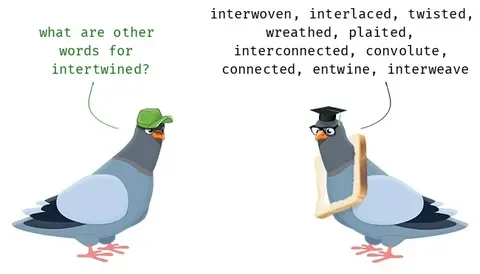
The entwined synonyms and intertwined synonyms overlap because the two words themselves overlap. Depending on context, words such as twisted, woven, connected, linked, bound, coiled, and interwoven can express related ideas. However, each synonym adds a slightly different shade of meaning.
For example, entangled often suggests difficulty or disorder. Connected is much broader and less visual. Interwoven strongly suggests weaving. Interconnected focuses on relationships between parts. Good writers therefore choose a synonym based on the exact image or relationship they want to express.
Entwine vs. Intertwine
The verbs entwine and intertwine are closely related. Cambridge defines entwine around twisting things together or around something. It defines intertwine around twisting together or being connected in a way that makes separation difficult. Their shared core explains why the two forms are often confused.
Entwined vs. Interwoven
The entwined vs interwoven comparison is useful because interwoven strongly suggests several elements being woven together. Cambridge defines interweave as combining two or more things so they cannot easily be separated. Thus, interwoven can feel especially natural for stories, themes, cultures, and ideas.
Entwined vs. Entangled
The entwined vs entangled distinction is clearer. Entwined can describe a graceful or deliberate connection. Entangled often suggests being caught, trapped, or involved in a difficult situation. Cambridge uses entangle for things becoming caught in nets or ropes and for difficult involvement.
Entwined vs. Connected
The entwined vs connected distinction is mainly about imagery. Connected simply states that a relationship exists. Entwined creates a picture of things winding together. Therefore, “our ideas are connected” sounds neutral. “Our ideas are entwined” sounds more vivid and suggests a deeper or closer relationship.
Intertwined vs. Interconnected
The intertwined vs interconnected comparison is also useful. Interconnected focuses on relationships among parts. Cambridge defines interconnecting as connecting two or more things or relating them to one another. Intertwined adds stronger imagery of things being woven or difficult to separate.
Common Mistakes With Entwined and Intertwined
One of the biggest common mistakes is assuming that each word has one fixed meaning. English does not work that neatly here. Dictionary evidence shows that both can describe physical twisting and abstract connection. Cambridge even uses entwined for politics, economics, business, history, and ideas.
Another mistake is thinking intertwined always sounds more formal. It can certainly work well in formal writing, but entwined can also appear in serious academic or analytical contexts. The better choice comes from meaning, context, and style. Native English usage allows considerable overlap between these two words.
Mistake 1: Treating Them as Completely Different Words
It is inaccurate to memorize a rule saying “entwined means emotional” and “intertwined means structural.” Both words can describe emotional and structural relationships. Cambridge’s examples of entwined include politics, economics, history, and business.
Mistake 2: Assuming Intertwined Is Always More Formal
Intertwined often appears in discussions about systems, history, technology, and economics. That does not make entwined informal. Both words can appear in journalism, academic writing, literature, and everyday English. The word choice should follow the intended meaning instead of an assumed formality scale.
Mistake 3: Using the Wrong Preposition
Another common problem involves prepositions. Physical writing often uses expressions such as “entwined around the branch.” Abstract writing frequently uses “entwined with history.” Similarly, “intertwined with technology” is natural. Learning these collocations helps you create smoother sentence patterns.
Mistake 4: Confusing Entwined With Tangled
Something can be entwined without being messy. A pair of dancers can have entwined arms. A decorative plant can be entwined around a column. Tangled usually suggests disorder or difficulty. Therefore, entwined often describes the arrangement itself, while tangled can emphasize the problem created by that arrangement.
Read More About https://thenewsmagazine.org/requester-vs-requestor/
Mistake 5: Assuming the Words Are Only Physical
Both words have a strong physical image, but their figurative range is much wider. You can describe entwined relationships, intertwined cultures, intertwined ideas, intertwined systems, or intertwined economies. This figurative flexibility makes both words valuable parts of modern English vocabulary.
Entwined vs. Intertwined: Easy Memory Trick and Practice Quiz
A simple memory trick is to picture entwined as something winding closely around another thing. Picture intertwined as several things woven through one another. This is only a learning aid. It is not a strict grammar rule. Real English gives both words considerable overlap.
The safest approach is to ask yourself what image you want. If you want a sense of winding closeness, entwined may fit beautifully. If you want to stress mutual connection or several parts woven together, intertwined may feel stronger. Both can describe physical and figurative relationships.
Easy Memory Trick
Think of a climbing vine wrapping around a tree when you see entwined. Think of several threads crossing through one another when you see intertwined. Then remember one final point: both can describe physical connection, emotional connection, and abstract relationships. The context remains the deciding factor.
Quick Practice Quiz
| Sentence | Best fit |
| The vines were ______ around the fence. | Entwined |
| Their lives became deeply ______. | Either can work |
| The country’s economy is ______ with global trade. | Intertwined |
| Their fingers remained ______ during the walk. | Either can work |
| The novel contains several ______ storylines. | Intertwined |
| The old branches were ______ around the gate. | Entwined |
Final Takeaway
The entwined vs intertwined comparison is not a battle between a correct word and an incorrect one. Both words describe close connection, twisting, or weaving. Entwined can emphasize wrapping and closeness. Intertwined can emphasize mutual connection and complexity. When both work, choose the one that creates the clearest image for your reader.
[…] would suggest, and it’s worth taking a similarly practical look at whether a resource actually breaks down the numbers you need rather than just describing […]